Weatherization Assistance Program 2026: Who Qualifies and How to Apply
The Weatherization Assistance Program pays for free insulation, air sealing and heating safety repairs for households at or below 200% of poverty or on SSI. 2026 income limits, priority groups, renter rules, the $8,813 average and how to apply.

The short version
The Weatherization Assistance Program pays a local crew to insulate, air seal and fix unsafe heating in your home at no cost. You qualify at or below 200% of the 2026 poverty guidelines ($54,640 for three, $66,000 for four) or if someone gets SSI. Apply through your state's weatherization office; renters need the landlord's written OK.
The Weatherization Assistance Program (WAP) is a free, federally funded home energy upgrade for lower-income households. An auditor tests your home, then a local crew seals air leaks, adds insulation and fixes unsafe heating equipment when the numbers justify it.
You pay nothing, and renters can qualify too.
The U.S. Department of Energy (DOE) funds the program and states run it through local agencies. DOE says the program weatherizes about 32,000 homes a year with its own funds, and that households save an average of $372 or more a year on energy afterward.
Below you will find the 2026 income limits with a worked example, the priority rules, renter rules, the spending limit, the audit process and the funding outlook for 2027. Every figure was checked against DOE, HHS or Congress sources on November 23, 2026.
Key Takeaways
- You qualify if household income is at or below 200% of the federal poverty guidelines, or if someone in the home gets SSI. Some states also use the LIHEAP limit of 60% of state median income.
- At 200% of the 2026 HHS guidelines, the limit is $54,640 for a household of three and $66,000 for four in the 48 contiguous states and DC.
- Older adults, people with disabilities, families with children, high energy users and households with a high energy burden get priority.
- DOE’s average spending limit for program year 2026 is $8,813 per home. It is a statewide average, not a check you receive.
- Congress gave the program $369 million for fiscal year 2026. FY2027 funding was not final as of November 23, 2026; a stopgap law runs through December 11, 2026.
What the weatherization assistance program pays for
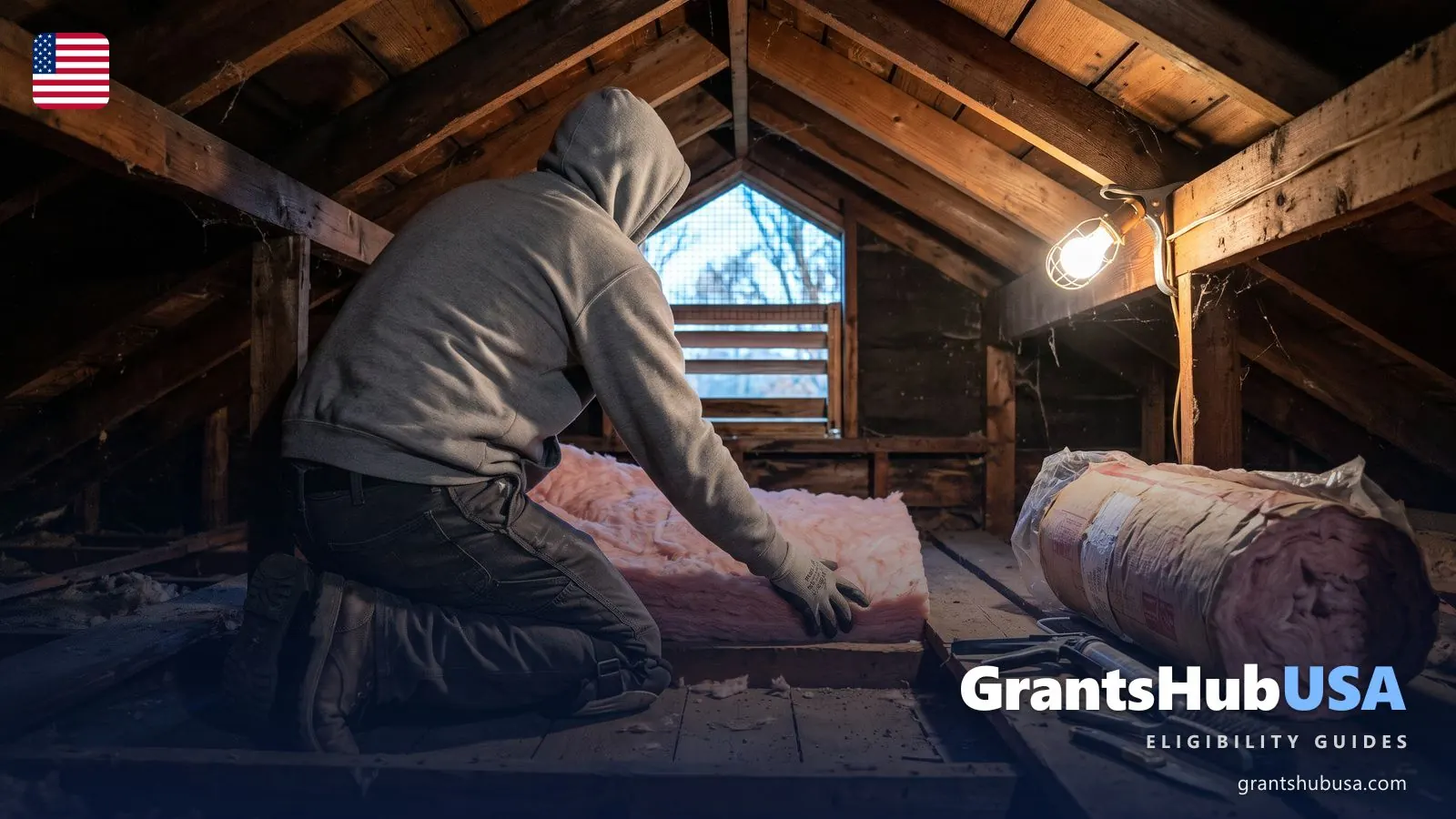
The weatherization assistance program pays a local crew to make your home use less energy and to fix energy-related safety problems. Typical work includes air sealing, insulation, duct sealing, and heating or cooling repairs. An energy audit decides which items your home gets.
That last point surprises people. You do not pick from a menu. DOE describes the audit as an assessment that produces “a recommended scope of work of the most cost-effective energy conservation measures for your home” on its How to Apply page, updated June 10, 2026.
So a drafty house with an empty attic will usually see insulation and air sealing before anything cosmetic. A new window competes with cheaper fixes on the same list, and it only makes the cut if the audit shows it pays for itself in energy savings.
Is a new furnace or HVAC system included?
It can be. The federal law behind the program lists “the cost of making heating and cooling modifications, including replacement” among the costs it covers (42 U.S.C. 6865(c)). Federal rules also allow spending to remove health and safety hazards that must be fixed before, or because of, the energy work.
In practice, a furnace that leaks carbon monoxide or a heating system that has failed is the kind of problem the program can address. A working system that is simply old may not qualify for replacement. Your auditor decides, based on safety testing and the energy math.
Small repairs the crew can make
Under 10 CFR 440.18, “incidental repairs” are allowed when they are needed to make the weatherization materials work. Patching a hole so insulation stays in place fits. A full kitchen remodel does not.
DOE’s July 2025 funding announcement adds a health angle. It says the program cuts “out-of-pocket medical expenses by an average of $514 per household.” It also says every federal dollar must return at least one dollar in energy savings (DOE, July 8, 2025).
Who qualifies for weatherization assistance in 2026
You can qualify three ways. Your household income is at or below 200% of the HHS poverty guidelines. Someone in the home got SSI or other cash aid in the past 12 months. Or your state lets you qualify under its LIHEAP rules. Both homeowners and renters can apply. Your local provider makes the final call.
The federal rule sits in 10 CFR 440.22. A home is eligible when family income is at or below 200% of poverty. It is also eligible when it “contains a member who has received cash assistance payments under Title IV or XVI of the Social Security Act” in the past 12 months.
Title XVI is Supplemental Security Income and Title IV covers TANF cash aid. That means an older adult or a person with a disability who receives SSI qualifies on that basis alone, without anyone adding up pay stubs.
DOE’s apply page adds the third route: “each state or territory may elect to use” the LIHEAP standard of 60% of state median income. In higher-income states, that can be a bigger number than 200% of poverty. DOE also lets states treat people in HUD means-tested programs as income eligible.
The 200% limits by household size
HHS published the 2026 poverty guidelines in January. Doubling them gives the 200% line. The figures below are our arithmetic from the HHS 2026 table for the 48 contiguous states and the District of Columbia.
| Household size | 2026 poverty guideline | 200% (yearly income limit) |
|---|---|---|
| 1 | $15,960 | $31,920 |
| 2 | $21,640 | $43,280 |
| 3 | $27,320 | $54,640 |
| 4 | $33,000 | $66,000 |
| 5 | $38,680 | $77,360 |
| 6 | $44,360 | $88,720 |
| 7 | $50,040 | $100,080 |
| 8 | $55,720 | $111,440 |
Alaska and Hawaii have higher guidelines. For a family of four, 200% works out to $82,500 in Alaska and $75,900 in Hawaii. For each person past eight in the contiguous states, add $11,360 to the 200% limit.
A worked example: a family of four
Say a couple in Ohio has two children. One parent earns $41,000 a year and the other earns $19,500 part time. Their gross household income is $60,500. The 200% line for four people is $66,000, so they are $5,500 under the limit and income eligible.
Now say the second job pays $27,000 instead. Income becomes $68,000, which is $2,000 over. Under the 200% test they would not qualify. If Ohio used the LIHEAP standard of 60% of state median income for weatherization, the answer could change, so the family should ask the local agency which test applies.
A household of three works the same way. A retired grandmother raising two grandchildren on $36,000 a year in Social Security and a pension is well under the $54,640 line for three.
Which year’s poverty table will your state use?
This is a real wrinkle. The newest DOE income notice on its program notices list, checked November 23, 2026, is WPN 25-3. It carries the 2025 guidelines and tells states to use them “until updated in subsequent policy documents.”
Some states may still screen with the 2025 table, which is slightly lower. If your income is close to the line, ask the agency which year it uses before you assume you are over or under.
What counts as income, and what does not
DOE’s definition of income in WPN 25-3 leaves out non-cash benefits such as Medicare, Medicaid, food stamps, school lunches and housing assistance. Child support you receive is not counted either. Your provider will ask for proof of income for the prior year, such as pay stubs or Social Security statements.
If another agency already checked your income, that helps. WPN 25-3 says a copy of your LIHEAP, HUD or USDA eligibility “will suffice as evidence of client eligibility.” That is one reason applying for LIHEAP first can speed things up.
Who moves to the front of the waiting list
Federal rules tell every state to give priority to elderly people, people with disabilities, families with children, high energy users and households with a high energy burden, meaning a big share of income goes to energy bills.
Meeting a priority category does not guarantee fast service, but it can move an application up the list.
The list comes straight from 10 CFR 440.16(b). Each state writes its own point system on top of it, so two neighbors in different states can wait very different amounts of time.
Energy burden is worth understanding. A retiree on a fixed income who pays a large slice of it for propane can rank higher than a larger family with lower bills relative to income. Bring a year of energy bills to your appointment so the agency can measure this.
Older adults can find more help on our seniors hub, and people with disabilities can start at the disability resources page. Both list programs that pair well with weatherization.
Renting? The landlord has to say yes in writing
Renters can get weatherization, but the provider needs written permission from the property owner before work starts. DOE says the provider “will work with you and your landlord to receive permission.” In buildings with several units, a minimum share of the units must also be occupied by eligible households.
The federal floor is that at least 66% of the units in a building must be eligible, or 50% for duplexes and four-unit buildings, under 10 CFR 440.22(b). Some HUD-assisted, public housing and tax-credit buildings are pre-approved on DOE lists.
Protections that come with the work
The same rule says the benefits must go “primarily to the low-income tenants.” For a reasonable time after the work, your rent should not go up because of it. States must run a complaint process, and the owner has to show any increase came from something other than the weatherization.
States may also ask landlords to accept a lien or other contract terms to protect the public investment if the owner sells or evicts. If your landlord hesitates, the agency can usually explain the terms directly.
If you are behind on rent rather than heating costs, weatherization is the wrong tool. See our guide to emergency rental assistance instead.
How much can be spent on one home in 2026
For program year 2026, DOE’s average spending limit for labor, materials and related costs is $8,813 per home. It is an average across all homes a state weatherizes, so one house can receive more and another less. It is not a grant paid to you, and you never see the money.
The base amount in federal law is $6,500, adjusted each year by inflation or 3%, whichever is lower. DOE set the 2026 figure in Weatherization Program Notice 26-1, issued July 9, 2026: “the adjusted average expenditure limit for PY 2026 is $8,813.”
Watch out for websites that promise a fixed “grant of $5,000” or similar. We could not find that figure in any DOE document. What a home gets depends on the audit, not a set payout.
A newer change matters for how fast agencies can work. On October 30, 2026, DOE’s WPN 26-4 said it will measure the average “over the full grant life cycle instead of year by year” and extended current grants to June 30, 2030. Agencies can now spend more on a hard house one year and less the next.
Solar water heating can count toward the average under federal rules. DOE also states that “there are no renewable electricity-generation technologies approved for use in WAP at this time,” so do not expect rooftop solar panels from this program.
What happens on audit day, step by step
Once your name comes up, a professional energy auditor visits, reviews your energy bills, runs a blower-door test to measure air leaks and inspects the attic, basement, living areas and appliances.
The auditor then writes a scope of work and explains it. Crews do the work, and an inspector checks it at the end.
- Intake. The provider confirms income and household size and puts you on the waiting list.
- Energy audit. The auditor runs the blower door, a large fan fitted in an exterior door frame, to find leaks.
- Health and safety checks. Combustion appliances get tested for carbon monoxide and venting problems.
- Scope of work. You get a list of the measures that pay back best, plus any safety fixes.
- Installation. Agency crews or contractors do the work on a schedule they explain to you.
- Final inspection. An inspector confirms the work meets DOE’s Standard Work Specifications and that equipment runs safely.
Clear a path to the attic hatch, crawl space and furnace before the visit. That alone can save a return trip.
How long the whole process takes is one of the most searched questions about this program. There is no national answer. It depends on the length of your local waiting list, crew capacity and the season, so ask the agency for its current estimate when you apply.
When a home gets put on hold instead of fixed
Some homes cannot be weatherized safely right away. A leaking roof would soak new attic insulation. Heavy mold, standing water, pests or major structural damage can do the same. In those cases the agency “defers” the home until the problem is fixed.
Congress created the Weatherization Readiness Fund to cut these deferrals. WPN 26-1 says it pays for “necessary repairs (e.g., health and safety issues, structural repairs)” so a home can move on to weatherization. Congress gave it $30 million for fiscal year 2026.
If your home is deferred, ask three things: what exactly must be fixed, whether readiness money is available locally, and whether a deferral keeps your place on the list. For older, very low-income rural homeowners, USDA’s Single Family Housing Repair Loans and Grants are one option DOE itself points to.
Homes slated for demolition or government purchase within 12 months are also skipped under federal rules. That is rare, but it can come up in redevelopment areas.
How to apply for the weatherization assistance program
Start with your state’s weatherization office, which you can find from DOE’s state map. The state site lists local providers, usually by county. Contact the provider for your county, fill out its application, and send proof of last year’s income for everyone in the household. Eligible applicants go onto a waiting list.
DOE’s How to Apply page lays out the order: identify your state weatherization administrator, find your local provider, complete the application, then prepare for services. “Some states offer an online application direct from their website, but most guide you to contact the local providers.”
Documents to gather before you call
- Proof of income for every household member for the prior year: pay stubs, Social Security or SSI award letters, pension or unemployment statements.
- Photo ID for adults, if your agency asks for it.
- Recent electric and heating fuel bills, ideally 12 months.
- Proof you own the home, or your landlord’s contact details if you rent.
- A LIHEAP, HUD or SNAP approval letter if you have one, since it can stand in as income proof in many states.
If you truly have no way to document income, WPN 25-3 allows self-certification only after other options fail, and it requires a notarized statement. Ask the agency before you go that route.
Many of the same community action agencies run LIHEAP. If you need help with this month’s bill as well as the long-term fix, ask for both in one visit. Our step-by-step LIHEAP application guide covers that side.
Is weatherization money still flowing in 2026 and 2027?
Yes, for now. Congress gave the program $369 million for fiscal year 2026 in a law signed January 23, 2026. For 2027, the administration asked for zero, the House Appropriations Committee recommended keeping $369 million, and a stopgap law funds the government only through December 11, 2026.
Here is how the 2026 money breaks down, from DOE’s WPN 26-2:
- $328 million in formula grants to states, territories and tribes, including $57.4 million for training.
- $30 million for the Weatherization Readiness Fund.
- $10 million for national training and technical help.
- $1 million in other costs.
Formula grants follow a mix of population, climate and residential energy spending, so large, cold states get the most. These were the largest FY2026 state allocations, including each state’s training share:
| State | FY2026 WAP allocation |
|---|---|
| New York | $28,945,471 |
| Michigan | $22,572,671 |
| Pennsylvania | $20,267,522 |
| Ohio | $18,796,428 |
| Illinois | $18,196,960 |
| Minnesota | $12,531,109 |
| Wisconsin | $11,482,267 |
| California | $10,229,030 |
| Indiana | $10,124,432 |
| Texas | $9,872,160 |
DOE moved grants to a July 1 start, so the 2026 program year runs July 1, 2026 to June 30, 2027. In October, DOE said it may pass recovered funds from older grants to states that opt in. WPN 26-4 adds that this “shall not be construed as a guarantee.”
What happened to the $3.5 billion from the infrastructure law?
The 2021 Infrastructure Investment and Jobs Act added $3.5 billion for weatherization. DOE’s notice WPN IIJA-7 extended those grants to June 30, 2029 and said DOE would obligate the remaining 50% of the money, with milestones attached.
In plain terms, that money is spread over several years and runs alongside the annual grants. It does not change who qualifies. It can mean more crews and shorter lists in states that are spending it well.
The FY2027 picture
A Congressional Research Service report updated June 23, 2026 says the FY2027 budget request asked for zero for DOE’s state and community energy office, which runs weatherization.
The House Appropriations Committee “did not accept the proposed elimination of weatherization funding, recommending the $369 million appropriated for FY2026” (CRS R48944).
No full-year FY2027 bill had passed as of November 23, 2026. The continuing resolution in P.L. 119-103 runs through December 11, 2026 (CRS R49353). Agencies already hold FY2026 grants through June 2027, so local work continues while Congress decides.
Can a home be weatherized a second time?
Yes, but usually only after 15 years. Federal law says a home weatherized under this program or another federal program “may not receive further financial assistance for weatherization” until 15 years after that earlier work was completed.
Federal rules make an exception for damage from fire, flood or another act of God that insurance does not cover.
The 15-year rule is in 42 U.S.C. 6865(c)(2). If you moved into a home and are unsure whether it was done before, the local agency can usually check its records by address.
Being on the wrong side of the 15 years does not block other help. The law still lets agencies give energy education and similar services to those homes.
Weatherization or LIHEAP: which one to ask for this winter
LIHEAP and weatherization solve different problems. LIHEAP, run by HHS, pays toward a heating or cooling bill or a shutoff emergency now. Weatherization, run by DOE, lowers what your home costs to heat and cool for years. Waiting lists mean weatherization is rarely the answer to a bill due this week.
The two connect. Federal law lets states move up to 15% of LIHEAP money into weatherization (25% with a waiver), many of the same agencies run both, and a LIHEAP approval can serve as income proof for weatherization. The smart move is to apply for both at once.
| Question | LIHEAP | Weatherization |
|---|---|---|
| Federal agency | HHS | DOE |
| What you get | Credit on your energy bill or fuel delivery | Insulation, air sealing, heating and safety repairs |
| Federal income test | Set by your state, within federal limits | 200% of poverty, SSI or cash aid, or the state’s LIHEAP test |
| Speed | Varies by state; crisis aid has federal response deadlines | Waiting list; varies by area |
| Renters | Yes | Yes, with landlord’s written OK |
If a gas shutoff is the urgent problem, our guide on getting help with a gas bill walks through utility hardship funds, payment plans and winter shutoff rules state by state.
More help with energy costs
- LIHEAP income limits and how to check if you qualify
- Ohio utility help, including HEAP and PIPP
- All utility assistance programs
- Housing help: Section 8, HUD-VASH and public housing
Five questions to ask your local agency
A short, specific call gets better results than a general inquiry. These five questions cover the gaps most people hit later in the process.
- Which income test do you use, and which year’s poverty table?
- How long is the current waiting list, and does my household get priority?
- Can my LIHEAP or SSI letter serve as proof of income?
- If I rent, will you contact my landlord, and does the owner pay any share?
- If my home has a roof or mold problem, do you have readiness funds to fix it first?
Write down the name of the person you spoke with and the date. If months pass without news, a follow-up call that cites that conversation usually gets a clear status. Programs, limits and funding change, so confirm details with your state before you rely on them.
Frequently asked questions
The federal limit is 200% of the HHS poverty guidelines. For 2026 that is $31,920 for one person, $43,280 for two, $54,640 for three and $66,000 for four in the 48 contiguous states and DC.
Households with a member on SSI qualify regardless, and some states use the LIHEAP limit of 60% of state median income instead.
It can. Federal law lets the program pay for heating and cooling modifications, including replacement, and for fixing energy-related health and safety hazards. Whether your system is repaired or replaced depends on the energy audit and safety tests, not on a request.
Yes. The local provider needs written permission from the property owner before work starts. In multi-unit buildings, at least 66% of units (50% in duplexes and four-unit buildings) must be eligible, and the landlord cannot raise your rent because of the work.
For program year 2026, DOE's average limit is $8,813 per home for labor, materials and related costs. It is an average across all homes a state weatherizes, so some homes get more and some less. The money goes to the work, not to you.
There is no national figure. Eligible households go onto a local waiting list, and the wait depends on demand, crew capacity and funding in your area. Older adults, people with disabilities, families with children and households with high energy costs get priority.
Usually only after 15 years. Federal law bars further weatherization funds for a home until 15 years after earlier federally funded weatherization was completed, with an exception for uninsured damage from fire, flood or similar disasters.
Sources & further reading
- 1U.S. Department of Energy: How to Apply for Weatherization Assistance (updated June 10, 2026)
www.energy.gov/cmei/scep/wap/how-apply-weatherization-assistance
- 2U.S. Department of Energy: Weatherization Assistance Program
www.energy.gov/cmei/scep/wap/weatherization-assistance-program
- 3DOE Weatherization Program Notice 26-1: Program Year 2026 Grant Application (July 9, 2026)
www.energy.gov/sites/default/files/2026-07/wap-wpn-26-1.pdf
- 4DOE Weatherization Program Notice 26-2: PY 2026 Grantee Allocations (July 9, 2026)
www.energy.gov/sites/default/files/2026-07/wap-wpn-26-2.pdf
- 5DOE Weatherization Program Notice 26-4: Grant Life Cycle Average Cost Per Unit (October 30, 2026)
www.energy.gov/sites/default/files/2026-10/wap-wpn-26-4.pdf
- 6DOE Weatherization Program Notice IIJA-7: IIJA Award Extension
www.energy.gov/sites/default/files/2025-04/wap-wpn-iija-7-revised_04142025.pdf
- 7HHS ASPE: 2026 Poverty Guidelines
aspe.hhs.gov/topics/poverty-economic-mobility/poverty-guidelines
- 8eCFR: 10 CFR 440.22, Eligible dwelling units
www.ecfr.gov/current/title-10/chapter-II/subchapter-D/part-440/section-440.22
- 9eCFR: 10 CFR 440.16, Minimum program requirements (priority groups)
www.ecfr.gov/current/title-10/chapter-II/subchapter-D/part-440/section-440.16
- 1042 U.S.C. 6865, Allocation of financial assistance (Cornell LII)
www.law.cornell.edu/uscode/text/42/6865
- 11Congressional Research Service R48944: Energy and Water Development FY2027 Appropriations
www.congress.gov/crs-product/R48944
- 12Congressional Research Service R49353: Continuing Appropriations for FY2027
www.congress.gov/crs-product/R49353
Confirm current rules with the agency that runs the program before you apply.
How we checked this guide
Every rule, dollar amount, and deadline in this guide was checked against the sources above on .
- Sources12 primary, linked above
- PublishedNovember 23, 2026
- Last verifiedNovember 23, 2026
- IndependenceNot a government agency
Not legal, tax, or financial advice. GrantsHubUSA is an independent editorial site. We are not a government agency and we do not run these programs. See our full disclaimer.
More guides for your next step

Emergency Heating Assistance: What to Do When Your Heat Is Off or Fuel Runs Out
Read article