Grants for Veterans: Housing, Car and Emergency Help in 2026
Real grants for veterans: VA housing grants up to $133,042 for FY 2027, a $27,908.90 automobile allowance, SSVF rent and utility help, state emergency funds and what VSO grants cover. There is no VA grant to start a business.

The short version
Grants for veterans are tied to a need. For FY 2027, VA housing grants pay up to $133,042 (SAH) or $26,654 (SHA), and the car allowance pays up to $27,908.90. SSVF nonprofits cover rent and utilities for veterans at risk of homelessness. There is no VA cash grant for general bills or for starting a business.
Most grants for veterans are tied to a specific need, not handed out as free spending money. The VA has no general cash grant you can apply for to cover bills or launch a business.
What it does have are large one-time grants for veterans with certain service-connected disabilities, plus emergency housing money paid through local nonprofits.
The biggest is the Specially Adapted Housing grant, worth up to $133,042 in fiscal year 2027. The VA automobile allowance pays up to $27,908.90 toward a vehicle. States, veteran groups and military relief societies add smaller emergency grants, each with its own rules.
This guide covers every program we could confirm on an official site on November 27, 2026: what it pays, who qualifies, and where to apply. It also flags the “veteran grant” offers that are really scams.
Key Takeaways
- There is no federal VA grant for general expenses or for starting a business. The Small Business Administration says it “does not provide grants for starting and expanding a business.”
- For fiscal year 2027 (October 1, 2026 to September 30, 2027), the VA housing grant maximums are $133,042 (SAH), $26,654 (SHA), and $53,585 or $9,568 for a temporary residence (TRA).
- The VA automobile allowance is up to $27,908.90, effective October 1, 2026. VA pays the seller, and you need approval before you buy.
- Veterans facing eviction or homelessness can get rent, utility, deposit and moving help through Supportive Services for Veteran Families (SSVF) grantees. VA awarded $855 million for FY 2027.
- Pennsylvania, Wisconsin and Minnesota run state emergency grants for veterans. Your county veteran service officer is the usual way in.
Is there free grant money for veterans?
Yes, but only for specific purposes. Real grants for veterans pay for home changes after a qualifying disability, a vehicle you can drive with that disability, rent or utilities when you are close to losing housing, and short-term needs through state or nonprofit funds. None of them is a no-strings check for any use.
That distinction matters because search results for “free money for veterans” mix grants with things that are not grants. VA disability compensation and VA pension are monthly benefits you earn by meeting eligibility rules, not grants you compete for.
If you are trying to figure out what your rating pays each month, see our VA disability rates guide or the VA disability rates calculator. For the extra pension money tied to daily-living help, see VA Aid and Attendance.
The Federal Trade Commission puts the warning plainly on its government grant scams page: “Real government grants require an application, and they’re always for a very specific purpose.” Every program below fits that description.
How a grant differs from a loan or a benefit
A grant does not have to be repaid. A loan does, even a zero-interest one from a relief society. A benefit, like disability compensation, is paid on a schedule as long as you stay eligible.
Several programs in this guide pay a vendor rather than you. The VA pays the car seller, SSVF grantees pay the landlord or utility, and Wisconsin pays the health care provider. Expect the money to go where the bill is, not to your bank account.
VA housing grants for veterans with disabilities: FY 2027 amounts
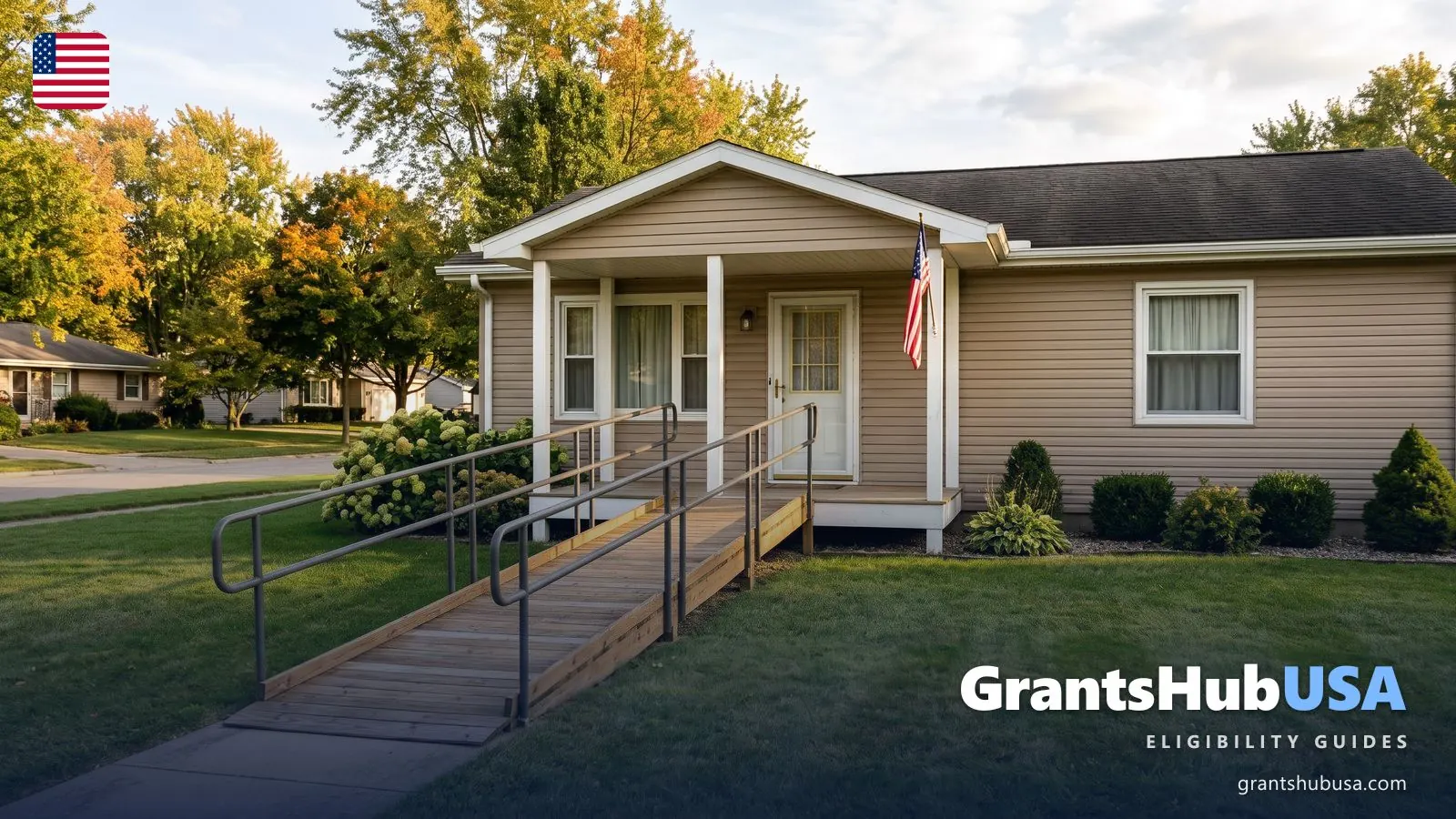
The VA offers three adapted housing grants. Specially Adapted Housing (SAH) pays up to $133,042 for fiscal year 2027, Special Home Adaptation (SHA) pays up to $26,654, and a Temporary Residence Adaptation (TRA) grant pays up to $53,585 or $9,568 to adapt a relative’s home you are living in.
Those maximums come from the VA’s disability housing grants page, last updated November 17, 2026. VA can adjust the cap each year based on construction costs, so check the page in the fiscal year you plan to build.
Who qualifies for an SAH grant
You must own the home or plan to, and you need a qualifying service-connected disability. VA lists these conditions:
- ALS (amyotrophic lateral sclerosis)
- Loss, or loss of use, of more than one limb
- Loss, or loss of use, of a lower leg along with the lasting effects of an organic disease or injury
- Blindness in both eyes with 20/200 visual acuity or less
- Certain severe burns
- Loss, or loss of use, of one lower extremity after September 11, 2001, so that you cannot balance or walk without braces, crutches, canes or a wheelchair
That last group has a ceiling. Congress allows only 120 veterans and service members each fiscal year to qualify on the single lower-extremity basis. If you qualify but the cap is reached, VA says you may be able to get the grant in a later year.
Who qualifies for an SHA grant
SHA is the smaller grant for a different set of disabilities: loss or loss of use of both hands, certain severe burns, and certain respiratory or breathing injuries. You or a family member must own or plan to own the home.
The TRA grant, if you live with family
A TRA grant helps when you are living for a while in a relative’s house that needs changes. You do not have to own that house, but you must qualify for SAH or SHA. The FY 2027 limit is $53,585 if you are SAH-eligible and $9,568 if you are SHA-eligible.
You can split the grant across projects
You do not have to spend the full amount at once. VA lets you use SAH or SHA money up to six times over your lifetime, and VA says you may receive up to the maximum in effect for the last year you use the grant. A ramp now and a bathroom later can both come from the same grant.
You can apply online with VA Form 26-4555, or by mail or in person. The VA how-to-apply page lists the steps and what a builder bid needs to include.
The VA automobile grant: up to $27,908.90
The VA automobile allowance pays up to $27,908.90 toward a specially equipped vehicle, effective October 1, 2026. It is a one-time payment that VA sends directly to the seller. You must have a qualifying service-connected disability and get VA approval before you buy.
The current figure is on VA’s special benefit allowance rates page. Cars, vans, motor homes, commercial trucks and farm machines like tractors can all count.
To qualify, at least one of these must apply because of a service-connected disability: loss or permanent loss of use of one or both feet, or one or both hands; permanent decreased vision in both eyes; a severe burn injury; or ALS. Ankylosis of a knee or hip qualifies you only for the adaptive-equipment grant.
Order matters: approval first
VA is direct about this: you cannot buy the vehicle first and file later. Submit VA Form 21-4502 online or by mail, wait for VA to sign the authorization section, then buy. Bring the original form when you pick up the vehicle, sign it, and give it to the seller.
The seller sends VA the form and an itemized invoice, and VA pays the seller. Make sure the dealer agrees to this before you sign anything.
Adaptive equipment is a separate grant
Power steering, power brakes, special seats, lifts and similar features fall under the adaptive-equipment grant. You apply with VA Form 10-1394 through the prosthetic representative at your local VA medical center. VA may pay you or the equipment seller.
You can usually get the automobile allowance once. VA allows a second one if you bought the first vehicle 30 or more years ago, or if a natural disaster destroyed it through no fault of yours and insurance did not cover the loss.
One smaller payment is worth knowing about. If a skin medicine, prosthetic or orthopedic device tied to your disability damages your clothes, VA may pay a clothing allowance of $1,053.19 (rate effective December 1, 2025).
Emergency housing money: SSVF temporary financial assistance
Supportive Services for Veteran Families (SSVF) is the closest thing to an emergency cash grant for veterans. VA funds local nonprofits that pay rent, utilities, deposits and moving costs for low-income veteran families who are homeless or about to lose their home. Payments go to the landlord or company.
VA announced on September 14, 2026 that $855 million in one-year SSVF grants would start October 1, 2026, part of $1.17 billion in homelessness grants to 680 organizations (VA news release).
What SSVF can pay for, and the limits
The federal rule for these payments is 38 CFR 62.34. It sets the caps in the table below. Each payment also comes with a plan, made with the grantee, for how you will cover the cost on your own afterward.
| Type of help | Federal limit | Who gets paid |
|---|---|---|
| Rent, including past-due rent and lease fees | Up to 10 months in a 2-year period, no more than 6 in any 12 months | Landlord |
| Rent for extremely low-income families | Up to 9 months in 12 months and 12 months in 2 years | Landlord |
| Utility bills, current or past due | Same month limits as rent | Utility company |
| Security deposit or utility deposit | Once every 2 years (each) | Landlord or utility |
| Moving costs (truck, movers, up to 3 months of storage) | Once every 3 years | Third party |
| Work and move-in items, housing application fees | $1,800 per 2 years in the rule, raised each year for inflation | Third party |
| Emergency housing when nothing else is open | 72 hours for a single veteran; up to 60 days for a family with dependents | Hotel or provider |
The $1,800 bucket is the one people miss.
It can cover uniforms, tools, certifications and licenses needed to keep or get a job, plus kitchen basics and bedding when you move in. The $1,800 figure is the base written into the regulation, which says the cap is adjusted every year by the consumer price index, so the current limit can be higher.
How to reach an SSVF grantee near you
You do not apply to VA for SSVF. You contact the local grantee that serves your county. VA posts a downloadable SSVF provider list on its SSVF program page.
If you are homeless now or about to be, call the National Call Center for Homeless Veterans at 877-424-3838. It is free, confidential and open 24 hours a day, and staff can connect you to the nearest VA and SSVF help.
SSVF is short-term. For a long-term rental voucher with VA case management, read our HUD-VASH guide. Veterans who do not qualify for SSVF can also check general emergency rental assistance.
State emergency grants for veterans
Many states run their own emergency grants for veterans in a temporary money crisis. Pennsylvania pays up to $1,600 in 12 months, Wisconsin up to $3,000 in 12 months for lost income, and Minnesota offers a once-per-lifetime relief grant. You normally apply through your county veteran service office.
We checked these three on each state agency’s own site. Rules, amounts and funding change, so confirm with your county office before you count on the money.
Pennsylvania: Veterans Temporary Assistance
The Pennsylvania Department of Military and Veterans Affairs pays up to $1,600 in a 12-month period for food, shelter, fuel and clothing. It covers eligible veterans and unmarried surviving spouses who live in Pennsylvania and hit an unforeseen shortfall from illness, disability, job loss or disaster.
The need must be essential and not caused by misconduct, and you must show no other funds are available. Receiving SNAP does not disqualify you. Bring your DD-214, proof of residency, proof of expenses and bills (DMVA VTA page).
Apply through the County Director of Veterans Affairs where you live.
Wisconsin: Subsistence Aid and Health Care Aid
Wisconsin’s Department of Veterans Affairs pays subsistence aid when you lose income because of illness, injury or a natural disaster and other aid is used up. Grants run in 30-day periods for up to 90 days, with a cap of $3,000 in any 12 months.
The companion Health Care Aid grant covers dental care up to $800 a year, vision care up to $400 a year and hearing aids up to $1,875 each every 24 months. Both grants together have a $7,500 lifetime limit (WDVA grant page).
Apply within 12 months of the income loss, through your County or Tribal Veterans Service Office.
Minnesota: Veteran’s Relief Grant
Minnesota’s Veteran’s Relief Grant is a once-per-lifetime payment to help a veteran or dependents stabilize after a hardship. Requests are reviewed case by case, and you must show you can stay afloat after the help ends. The state pays your chosen vendors directly.
The MDVA page does not publish a dollar cap. Ask your County Veteran Service Officer, or call LinkVet at 1-888-546-5838.
Finding the program in your state
Start with your county veteran service officer. These officers process state grant applications, and several states route their relief funds only through them. Then check your state veterans agency’s site for words like “temporary assistance,” “relief fund” or “emergency grant.”
Our veterans benefits hub collects VA programs in one place, and the emergency help hub covers non-veteran options such as utility and food aid.
Nonprofit and military relief grants, and who they really serve
Veteran service organizations and military relief societies do give grants, but many lists overstate who can get them. Several of the best-known programs serve active-duty members, their children or Army retirees, not every veteran. Read the eligibility line before you apply.
| Program | Who it serves | What it gives |
|---|---|---|
| VFW Financial Assistance for Service Members | Active-duty members, including activated Guard and Reserve, and their families | Grant up to $2,500 for daily necessities, paid to the creditor |
| American Legion Temporary Financial Assistance | Minor children of active-duty members and of American Legion members | Cash grants for the children’s needs |
| Army Emergency Relief | Soldiers, retired Soldiers and their families | Grants and zero-interest loans |
The VFW program was known as Unmet Needs, and older articles still describe it as a grant for any veteran. Its current page limits it to active-duty service members and activated Guard and Reserve members with hardship tied to deployment or other military activity or injury.
The American Legion TFA program has paid cash grants for minor children since 1925. If you are a Legion member with kids at home, your local post or department adjutant is the place to ask.
If you retired from the Army, Army Emergency Relief takes applications online for grants and zero-interest loans. A veteran who separated without retiring is outside the audience AER describes, so check the eligibility page before applying.
Are there grants for veterans to start a business?
No federal agency gives veterans a grant to start or grow a business. The SBA states on its grants page that it “does not provide grants for starting and expanding a business.” What veterans get instead is free training, counseling, SBA-backed loans and contracting programs.
This is where many “veteran business grant” pages go wrong. The real federal help is substantial, it just is not cash:
- Boots to Business: SBA’s entrepreneurship course inside the Defense Department’s Transition Assistance Program. Boots to Business Reboot extends it to veterans of any era, including Guard and Reserve.
- Revenue Readiness: a six-week online follow-up course that turns an idea into a business model, open after either Boots to Business course.
- Veterans Business Outreach Centers (VBOCs): business plan workshops, concept reviews and mentoring. SBA counted 51 VBOC locations in its November 9, 2026 Veterans Small Business Week announcement.
- SBA-guaranteed loans: SBA’s Lender Match tool connects you to lenders that offer them. See our SBA 7(a) loan program guide.
- Military Reservist EIDL: loans for small businesses hurt when an essential employee is called to active duty.
- VetCert: SBA certification for veteran-owned small businesses that want a share of federal contracts set aside for them.
SBA lists all of these in the veteran-owned section of its Grow your business page, along with the Office of Veterans Business Development at 202-205-6773.
The VA self-employment track
If you have a service-connected disability rating of at least 10% and a barrier to employment, VA’s Veteran Readiness and Employment (VR&E, Chapter 31) program has a self-employment track. A counselor helps build and review a business plan, analyzes the concept and arranges small-business training.
VA then decides whether self-employment is a viable goal for you. It is a rehabilitation plan, not a grant check, so apply on the VR&E page with VA Form 28-1900 and treat it as structured support. Our small business hub covers the loan side.
Is the GI Bill a grant?
No. The GI Bill is an education benefit you earn through service and use under VA rules. It does not compete with other applicants the way a grant does. Start with VA’s GI Bill overview.
Veterans can still get a true education grant. The federal Pell Grant is need-based, and veterans apply for it through the FAFSA like any other student. See our Pell Grant eligibility guide.
What does the Big Beautiful Bill do for veterans?
The One Big Beautiful Bill Act, the 2025 tax and spending law that USDA now calls the Working Families Tax Cut Act, did not create a cash grant for veterans. Its effects on veterans run through tax changes and through new work rules in Medicaid and SNAP.
The White House fact sheet on the law for veterans highlights the tax provisions and “exemptions for 100% disabled veterans from the work requirements in Medicaid” (White House, July 2025). Our Medicaid work requirements guide lists every exempt group and state start dates.
For SNAP, USDA says on its work requirements page (updated November 3, 2026) that it is still writing guidance on how the law changes the exceptions for adults without dependents. Check our SNAP work requirements guide and your state SNAP office before assuming you are excused.
For health coverage options beyond VA care, see Medicaid for veterans.
Veteran grant scams: nobody charges for a federal grant
Any call, text or ad that offers a veteran “free grant money” for a fee is a scam. The FTC says the government will not contact you out of the blue about grants, never asks for an up-front fee, and never takes gift cards, wire transfers or cryptocurrency. The only full list of federal grants is free at Grants.gov.
The VA’s fraud protection page cites an FTC estimate that veterans reported $292 million in fraud losses in 2022. Grant offers are a common hook because veterans really do have benefits to protect.
Watch for these signs, all drawn from FTC and VA guidance:
- You were contacted first, by phone, text, email or social media, about a grant you never applied for.
- The caller says you qualify, then asks for your Social Security number or bank account.
- There is a “processing” or “release” fee, especially by gift card, cash reload card, wire or crypto.
- The agency name sounds official but does not exist. The FTC’s example is the “Federal Grants Administration.”
- Someone wants a fee to file a VA claim and promises a faster decision or a higher rating. VA calls these people claims predators.
Use only VA-accredited attorneys, claims agents or veteran service organization representatives for VA claims.
To report a scam, call the VSAFE Fraud Hotline at 833-388-7233 or file at ReportFraud.ftc.gov. If you already paid, contact the gift card, wire or crypto company right away and ask it to reverse the transaction. Our Scam Watch hub tracks other benefit scams.
Which grant fits your situation?
Match the problem in front of you to the program built for it. This table points to the first call to make.
| Your situation | Program to check first | First step |
|---|---|---|
| Need ramps, wider doors or an accessible bathroom because of a service-connected disability | SAH or SHA grant | Apply with VA Form 26-4555 |
| Staying with family while recovering and their home needs changes | TRA grant | Apply through the same VA housing grant process |
| Cannot drive a standard vehicle because of a service-connected disability | Automobile allowance and adaptive equipment | VA Form 21-4502 before you buy |
| Behind on rent or facing eviction, low income | SSVF | Call 877-424-3838 or a local SSVF grantee |
| Short-term crisis from job loss, illness or disaster | State veteran emergency grant | County veteran service officer |
| Want to start a business | VBOC, Boots to Business, SBA loans, VR&E self-employment | Find your nearest VBOC on sba.gov |
| Want to go to school | GI Bill (benefit) and Pell Grant (grant) | VA education page and the FAFSA |
Two programs on this list pay out in the tens of thousands, and both depend on a service-connected disability rating. If you have a condition from service that VA has not rated yet, filing that claim may be the step that opens the housing and vehicle grants.
Related reading:
- VA disability rates and monthly payments
- VA Aid and Attendance pension
- HUD-VASH vouchers for homeless veterans
- HUD-VASH program page
- Emergency housing assistance
- Help for people with disabilities
Frequently asked questions
Not for general use. VA grants pay for specific things: adapting a home or vehicle after a qualifying service-connected disability, and rent or utilities through SSVF nonprofits when you are at risk of homelessness. Disability compensation and pension are monthly benefits, not grants.
For fiscal year 2027 (October 1, 2026 to September 30, 2027), the SAH maximum is $133,042. The SHA maximum is $26,654. A TRA grant for a relative's home pays up to $53,585 if you are SAH-eligible or $9,568 if you are SHA-eligible.
The VA automobile allowance pays up to $27,908.90 toward a specially equipped vehicle, effective October 1, 2026. VA pays the seller directly, and you must get approval with VA Form 21-4502 before you buy. Adaptive equipment is a separate grant.
No federal agency offers one. The SBA says it does not provide grants for starting and expanding a business. Veterans can use free Boots to Business training, Veterans Business Outreach Centers, SBA-guaranteed loans and, with a disability rating, the VA VR&E self-employment track.
Contact a local Supportive Services for Veteran Families (SSVF) grantee or call the National Call Center for Homeless Veterans at 877-424-3838. SSVF can pay rent, utilities, deposits and moving costs directly to the landlord or company for eligible low-income veteran families.
It did not create a grant for veterans. Its veteran effects run through tax changes and work rules, including a Medicaid work requirement exemption for veterans rated 100% disabled. USDA is still issuing guidance on how it changes SNAP work-rule exceptions.
No. The FTC says real government grants never require an up-front fee, and the government does not contact people out of the blue about grants. Report the offer to the VSAFE Fraud Hotline at 833-388-7233 or ReportFraud.ftc.gov.
Sources & further reading
- 1VA: Disability housing grants for Veterans (updated Nov 17, 2026)
www.va.gov/housing-assistance/disability-housing-grants/
- 2VA: Current special benefit allowances rates (updated Oct 1, 2026)
www.va.gov/disability/compensation-rates/special-benefit-allowance-rates/
- 3VA: Automobile allowance and adaptive equipment
www.va.gov/disability/eligibility/special-claims/automobile-allowance-adaptive-equipment/
- 4VA News: VA awards $1.17 billion in grants to fight Veteran homelessness (Sep 14, 2026)
news.va.gov/press-room/va-awards-1-17-billion-in-grants-to-fight-veteran-homelessness/
- 5VA Homeless Programs: Supportive Services for Veteran Families
department.va.gov/homeless/supportive-services-for-veteran-families/
- 6eCFR: 38 CFR 62.34, SSVF other supportive services
www.ecfr.gov/current/title-38/chapter-I/part-62/subpart-C/section-62.34
- 7SBA: Grants
www.sba.gov/loans/additional-funding-opportunities/grants/
- 8SBA: Grow your business, veteran-owned businesses
www.sba.gov/counseling/grow-your-business/
- 9VA: Veteran Readiness and Employment (Chapter 31)
www.va.gov/careers-employment/vre/
- 10Pennsylvania DMVA: Veterans Temporary Assistance
www.pa.gov/agencies/dmva/pennsylvania-veterans/pa-vetconnect/state-veterans-programs/financial-assistance/benefits--veterans-temporary-assistance
- 11Wisconsin DVA: Subsistence Aid and Health Care Aid Grants
dva.wi.gov/services/mental-health-and-emergency-services/subsistence-aid-health-care-aid-grants/
- 12Minnesota MDVA: Veteran's Relief Grant
mn.gov/mdva/resources/familyassistance/veteransreliefgrant.jsp
- 13VFW: Financial Assistance for Service Members
www.vfw.org/assistance/financial-grants
- 14FTC: Government Grant Scams
consumer.ftc.gov/articles/government-grant-scams
- 15VA: Protecting Veterans from fraud
www.va.gov/initiatives/protecting-veterans-from-fraud/
- 16USDA FNA: SNAP Work Requirements (updated Nov 3, 2026)
www.fna.usda.gov/snap/work-requirements
Confirm current rules with the agency that runs the program before you apply.
How we checked this guide
Every rule, dollar amount, and deadline in this guide was checked against the sources above on .
- Sources16 primary, linked above
- PublishedNovember 27, 2026
- Last verifiedNovember 27, 2026
- IndependenceNot a government agency
Not legal, tax, or financial advice. GrantsHubUSA is an independent editorial site. We are not a government agency and we do not run these programs. See our full disclaimer.
More guides for your next step